
Nearly two years into the COVID pandemic, we are now gaining control over the deadly virus that has shaken the world as we knew it. The catastrophic loss of human lives and global economic devastation reminded us of how vulnerable we are and how inadequate our ability is as humans to protect ourselves in our own natural habitat: indoor spaces.
But as the pandemic draws to a close, the same issues that brought us to this place still exist. Manual disinfection with chemical substances is still considered “state of the art”. We have done little to improve the quality of the air we breathe 18,000 times a day. We also remain vulnerable to seasonal flu, the common cold, norovirus, MRSA, and even the next pandemic. If we continue to neglect the health of the buildings in which we live, work, learn, and play, we will squander a once-in-a-generation opportunity (and even obligation) to build a safer, healthier, and more productive “normal” – and we will have done so at the expense of human health.
Innovating to improve the health of our natural habitat – indoor spaces – is the most important and pressing challenge for human health in our generation.
The problem remains – How do we improve indoor health?
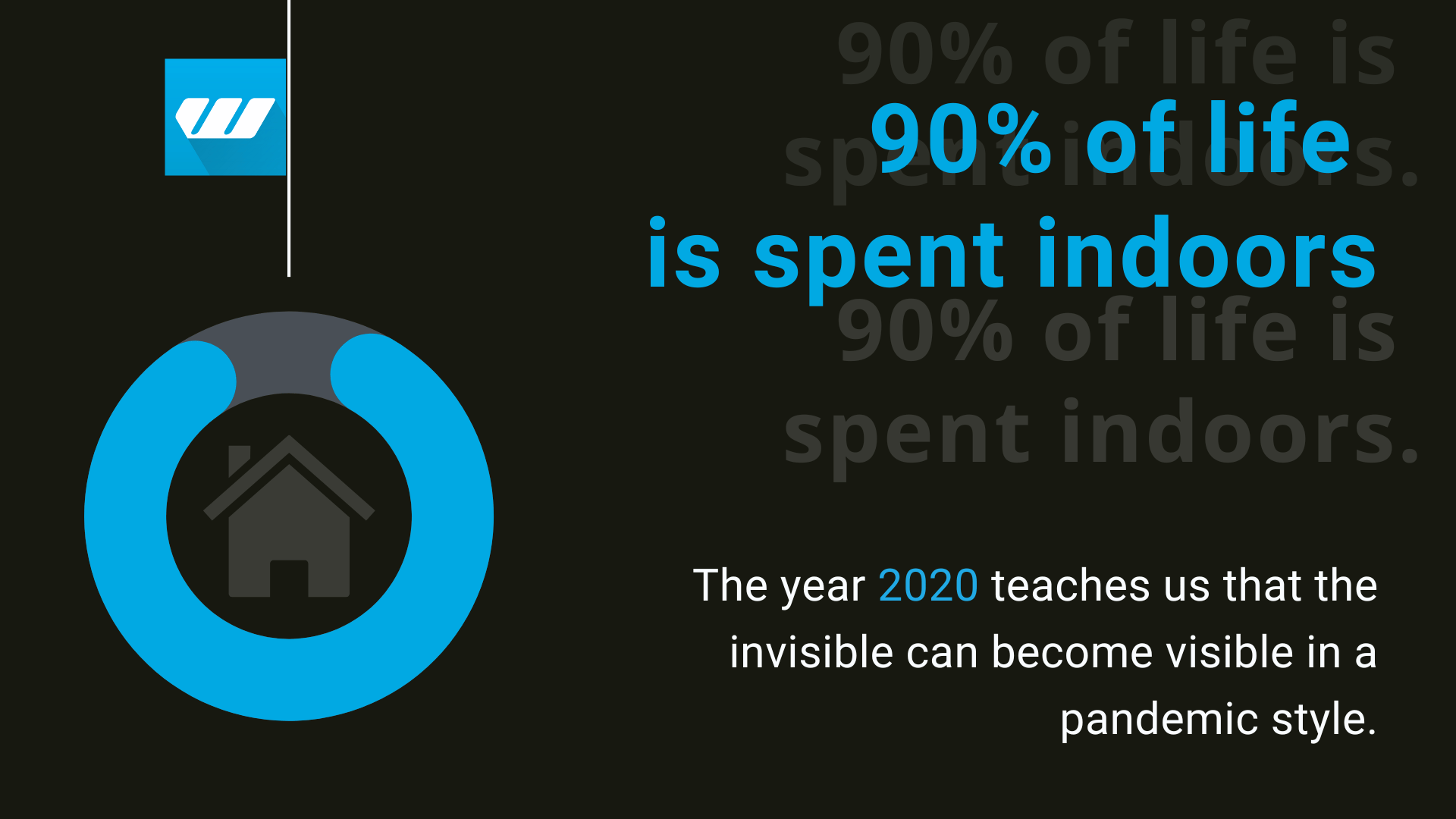
Fact: Humans are an indoor species. We spend 90% of our lives indoors, so by the time we reach 78.2 years (life expectancy in Romania in 2019), we will have spent a total of 70 years indoors. The implications of this reality are huge: indoor spaces have a massive impact on our overall health.
Despite the universal importance of human health and the undeniable link between indoor environmental health and the health of the people who occupy them, we have failed to create solutions that effectively keep us safe. In fact, the spaces in which we spend the vast majority of our lives actually make us sick.
ECDC data provides overwhelming evidence: even before COVID, around 30% of Europe’s population had the flu each year, leading to almost 72,000 deaths annually and 650,000 deaths globally (according to the World Health Organization). Somehow, we have accepted that this is normal. Adults get colds an average of 3 times a year, and children up to 10 times a year. There are up to 21 million cases of norovirus (stomach flu) annually, 1.5 million emergency room visits for pneumonia in the US, and MRSA (Methicillin-resistant Staphylococcus aureus) kills more people annually than Parkinson’s disease, emphysema, AIDS, and homicide combined.
If we look at how we currently combat the spread of these common infectious diseases, it’s no wonder we fail. The current “best practices” are to wash our hands and spray our surfaces with chemicals, then wipe them down – but these are the same preventive measures we used to fight the Spanish flu pandemic in 1918.
In the 100 years since the Spanish flu pandemic, we have sent people to the moon, invented the internet, seen the proliferation of self-driving cars, and created rockets that can reach space before landing on an autonomous drone in the middle of the ocean. Yet, we still use the same archaic chemicals to fight COVID today, in 2021.
We collectively take responsibility and even obligation to do better.
Justification for investments in healthy buildings – Innovation and Health. UV Lamp. UV Robots.
At first glance, the benefits of creating and maintaining healthy indoor environments may seem altruistic: improving health and therefore quality of life, something we can all agree is a good thing. However, there is significant financial and other value creation for almost any organization that invests in healthy building infrastructure.
Poor health cost US employers approximately $575 billion in 2019 due to direct and indirect costs associated with healthcare and lost productivity.
Reducing sick days generates a significant ROI for any organization. Let’s look at two very different types of organizations: a business and an educational institution.
Example No. 1 – Business
Increasing employee productivity. Employees that are ill are less effective. Employers may have to make replacement hires, which results in both direct and indirect costs. The opportunity cost is significantly larger for sectors like banking, technology, professional services like law firms, or other highly compensated sectors. The most expensive and most precious resource for a business is its employees. Businesses pay startling sums of money to reduce operating costs or energy use, which can account for 5–10% of overall costs, but investing in employee productivity and wellness would be a much better investment with much bigger return.
Reducing health insurance premiums. The average cost of health insurance in Europe is about 7500EUR per year. Employers often incentivize employees with gym memberships and smoking cessation programs. The motivations may be partly altruistic, but the main driver for these programs is to reduce health insurance premiums. Creating a safe and healthy work environment and reducing employees’ number of sick days has an impact on the direct and indirect costs related to healthcare, reduces the risk profile of an organization’s employee base, and ultimately lowers premiums. An example of the inverse of this effect is Delta Airlines. Delta employees who are not vaccinated against COVID are charged $200/month for health insurance due to increased risk and corresponding increased treatment costs.
There are more benefits than just material ones, such as employee engagement, retention, peace of mind, and performance (healthy buildings actually make employees perform better in 9 cognitive domains).
Example No. 2 – Education
It takes money to bring in a substitute instructor when a teacher is absent from class.
When a student is absent from school because they are sick, the quality of learning drops significantly. A teacher who is absent from school has the same effect, but on the entire class. In fact, just one year of absences of more than 10 days in high school increases the likelihood of a student dropping out of school by 7 times. Student performance also affects test results. It would be hard to find an educator who wouldn’t agree that keeping students and teachers healthy and in the classroom leads to improved educational quality.
The same principles apply practically to any type of organization. Fundamentally, creating value comes from two outcomes of healthy buildings: improving human health by reducing sick days and improving performance. The altruistic argument for investing in safer indoor environments is uncontroversial, but the economic support is also solid.
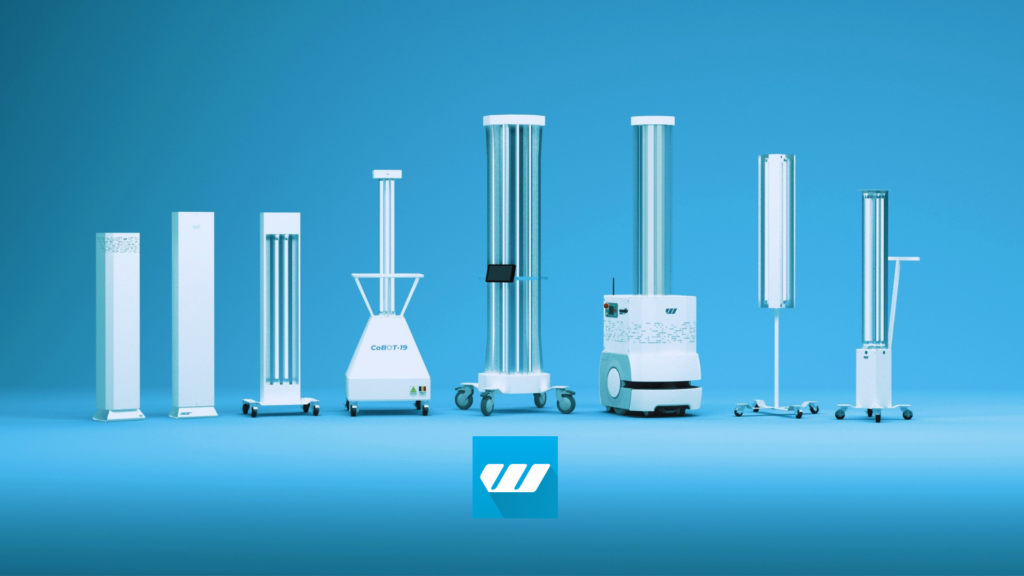
The continuous and autonomous disinfection ecosystem of Wolf-e Robotics.
Wolf-e Robotics was born during the pandemic as a response to this moment. We exist to reduce the spread of infectious diseases and to fundamentally change the way we think about keeping people safe in indoor spaces. Our product represents the intersection of science, health, and technology and enables organizations of all shapes and sizes to improve the health and safety of their indoor environment and, consequently, improve the health of the people they serve. We are talking about purifying, filtering, disinfecting, and sterilizing air and surfaces.
We have combined UVC disinfection commonly found in clinical settings with modern technologies to create an ecosystem that works continuously and automatically to disinfect air and surfaces in real-time. Our products offer a holistic solution that can address any use case and can be combined to form a customized solution adapted to any indoor space. Whether we are talking about an air purifier, a bactericidal UV lamp, a medical UVC lamp, a UV sterilization lamp, UV robot, UVC robots or simply a UV lamp, we put technology at the forefront, in the service of health.
To put it another way, we can now visit any physical place, get some fundamental data about how the facility is used and configured, and then construct a tailored solution that maximizes risk reduction in that particular environment. The end result is an extraordinary effectiveness that has a significant positive impact on the health of those who use the area.
All of these are linked together on our platform, which ensures compliance and traceability of a process that was previously invisible and impossible to audit.
The future
To date, over 52,000 people have died in Romania and over 5 million worldwide due to COVID. We should be ashamed if we let them die in vain. We must emerge from this pandemic better, stronger, and healthier than ever. We must invest in human health by protecting our natural habitat – indoor spaces!
The sincere hope is that technology (like the one we propose) becomes ubiquitous and integrated into the built environment infrastructure in all the places where we treat, work, and learn. All organizations stand to gain from improving the health and safety of the physical spaces they own and manage, and we as a society will enjoy these effects.
We envision a world where classroom attendance is increasing and sick leave is decreasing; a world where buses, trains, and airplanes are no longer metal boxes teeming with viruses and bacteria. In the world we see, schools are no longer considered Petri dishes, and the office is a place where we share ideas, not communicable diseases. Now is the time to mark the beginning of a new era.
We are witnessing a paradigm shift, if you’re not on-board, you’re taking risks!
We move forward!
————————————————————————————————————
We are Wolf-e Robotics, and every day we work to support our mission of disinfecting the air and surfaces in the places where we work, learn, and spend our time. Through disinfection with intelligent UVC light equipment and mobile robots, we provide the most efficient and environmentally friendly method of inactivating microorganisms on surfaces and in the air. With applicability in the medical, commercial, transportation, education, and corporate sectors.
Follow us on Facebook, Twitter and LinkedIn!


