
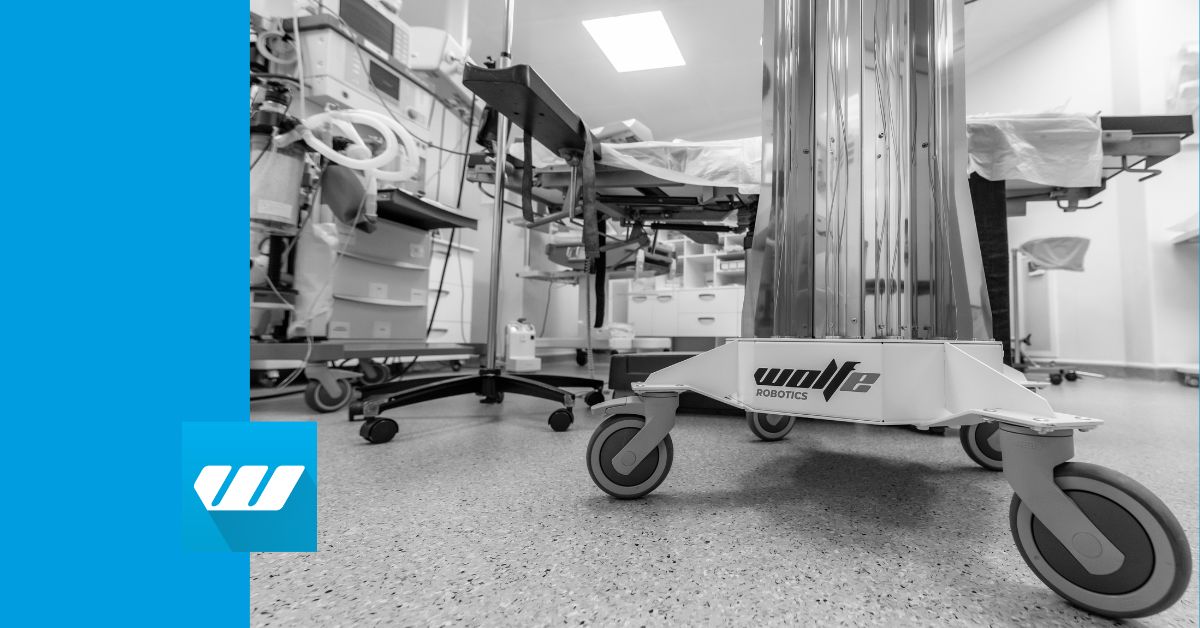
At Wolf-e Robotics, our aim is to support medical teams in this process. We start from a shared objective: well-organized disinfection processes that can be implemented consistently and verified. UV-C disinfection in operating rooms and ICUs thus becomes an important additional layer of protection, integrated into departmental routines and aligned with established cleaning and disinfection procedures, supporting medical teams in their efforts to prepare a safe environment for every patient.
In Critical Care Areas, We Look at the Entire Process
In an operating room, environmental preparation includes the surfaces and equipment components specified in the relevant protocol. In ICUs, the same attention must be given to the patient’s immediate surroundings and the objects used in care, including those moved between beds.
The CDC recommendations on Candida auris, updated on September 30, 2026, emphasize that shared equipment can contribute to transmission. Such equipment must be cleaned and disinfected after each use, with clearly assigned responsibilities and a clear separation between equipment that is ready for use and equipment that still requires reprocessing.
This perspective helps us connect room disinfection with the disinfection of objects used within it. Preparing the environment and reprocessing equipment must be coordinated so that no step is overlooked because responsibilities are unclear.
Data from Romania Reinforce the Need for Attention in ICUs
A study published in Microbiology Spectrum in 2025 retrospectively analyzed 102 patients with Candida auris identified in Romania between 2022 and 2023. Of these, 80 were hospitalized in an ICU or had recently been transferred from one at the time of detection. The authors classified 57 cases as infections, including 29 bloodstream infections. These figures describe the study population, not national incidence or the situation across all Romanian hospitals.
The findings provide a concrete reason to pay close attention to processes in intensive care settings. However, interpreting them requires distinguishing colonization from infection and understanding how cases were identified. The same caution is necessary when analyzing changes in a hospital’s reported cases. An increase in reported cases does not, by itself, demonstrate a deterioration in patient safety. To understand such changes, detection practices, reporting, patient characteristics, and care conditions must be considered together.
Clear Responsibilities Support Continuity
Between surgical procedures or when an ICU bed becomes available, we can examine the entire process: Who initiates cleaning? Who is responsible for the external surfaces of equipment? Who verifies that the area is ready?
Consider the preparation of an ICU bed after a patient has been transferred. The bed area and reusable equipment undergo the reprocessing procedures established by the relevant protocol. If a piece of equipment must be handled by another staff member, responsibility for that task must remain clear, including during shift changes.
This is an illustrative example, but it shows why written procedures must be supported by an organizational approach that works within the department’s daily routine. A simple, accessible record can help the team identify what has been completed and what still needs to be done.
Each Component Has Its Own Requirements
UV-C environmental disinfection and medical device reprocessing must be coordinated according to the intended use of each item. External surfaces, accessories, and equipment components may have different requirements. Therefore, the choice of method must be based on the manufacturer’s instructions and the applicable protocol, including material compatibility and the required contact time of the disinfectant used.
In operating rooms, environmental disinfection does not replace the sterilization of instruments that require it.
This distinction also helps determine where an additional UV-C disinfection step can be introduced, without assigning different functions to the same method.
UV-C Must Be Integrated into Real Clinical Conditions
For Candida auris, the CDC notes that evidence regarding no-touch technologies, including germicidal UV, remains limited and recommends their use as a supplement to standard cleaning and disinfection.
In operating rooms and ICUs, integrating UV-C requires assessing room configuration, the surfaces targeted, and exposure conditions. Its use must comply with the equipment’s safety requirements and be coordinated with clinical activities.
Completing a UV-C cycle in a room does not automatically confirm that every component within that room has been properly reprocessed. Likewise, laboratory results demonstrating the inactivation of a microorganism must be distinguished from clinical evidence showing a reduction in patient infections.
Verification Completes the Process: UV-C Disinfection in Operating Rooms and ICUs
Once the required steps have been completed, information must be available to verify their execution.
For the UV-C component, recording the room, device, operator, and actual cycle duration helps reconstruct the disinfection cycle and identify interruptions. This is where digital records from Wolf-e OS can contribute, alongside cleaning records and the healthcare facility’s established procedures.
These records document the UV-C stage; verifying the entire process also requires information about the other activities involved. We have explored the information needed to reconstruct and verify each cycle in our article on UV-C disinfection traceability in hospitals.
In operating rooms and ICUs, meaningful support for medical teams begins with connecting protocols, actual practice, and verification. Together, we can build processes in which every step is clearly defined, and any deviations can be identified, monitored, and followed through to resolution.
_______________________________________________________________________________________
We are Wolf-e Robotics, and every day we work to support our mission of disinfecting the air and surfaces in the places where we work, learn, and spend our time. Through disinfection with intelligent UVC light equipment and mobile robots, we provide the most efficient and environmentally friendly method of inactivating microorganisms on surfaces and in the air. With applicability in the medical, commercial, transportation, education, and corporate sectors.
Follow us on LinkedIn, X, Facebook and Instagram!
