
In our September newsletter, we discuss food safety and the role of prevention in the spaces through which food moves from production to the consumer. 866 million cases of illness and approximately 1.52 million deaths in a single year. These are the World Health Organization’s latest estimates of the impact of unsafe food worldwide.
Beyond its medical implications, the economic impact is estimated at approximately $310 billion annually, through medical costs and productivity losses. Children under five are disproportionately affected: although they account for approximately 9% of the global population, they bear almost one-third of the burden of diseases associated with unsafe food.
Europe is also part of this picture. In 2024, the European Union reported 6,558 foodborne outbreaks, 62,481 cases of illness and 3,336 hospitalisations. Compared with the previous year, the number of outbreaks increased by 14.5%, while the number of cases rose by almost 20%.
These figures put into perspective an issue that extends beyond healthcare: microbiological control of the spaces where we produce, store, sell and consume food.
For manufacturers and operators in the food industry, retail and hospitality, this translates into concrete responsibilities: consistently applied hygiene procedures, trained teams and verification of contamination prevention measures. For Wolf-e Robotics, the discussion starts here: how we integrate technology and disinfection processes into day-to-day operations.
From Production to the Consumer
Microorganisms such as Salmonella, Listeria monocytogenes, E. coli and Campylobacter can contaminate food and pose a risk to consumers’ health. This risk must be controlled throughout the product’s journey: from processing and packaging to storage, transport, retail and food service.
Food safety should therefore be viewed as a continuous chain of risk control, from the production environment to the shop, restaurant and, ultimately, the consumer.
Where Can UV-C Play a Role?
UV-C radiation is studied for its ability to inactivate microorganisms. In the food industry, research has examined its use against microorganisms such as Salmonella, Listeria monocytogenes and E. coli. Applications can target both surfaces and air, although the way the technology is used varies depending on the space.
In food production facilities, UV-C can complement conventional procedures by treating certain surfaces and equipment after cleaning and washing. In processing, packaging and storage areas, air treatment can add an additional level of microbiological control, particularly in spaces where products are exposed to the surrounding environment.
In retail, the environment involves heavy foot traffic and numerous frequently touched surfaces: shopping trolleys and baskets, handles, checkout areas, payment terminals, counters and display cases. Direct UV-C surface disinfection can be carried out under controlled conditions, generally when the public is absent.
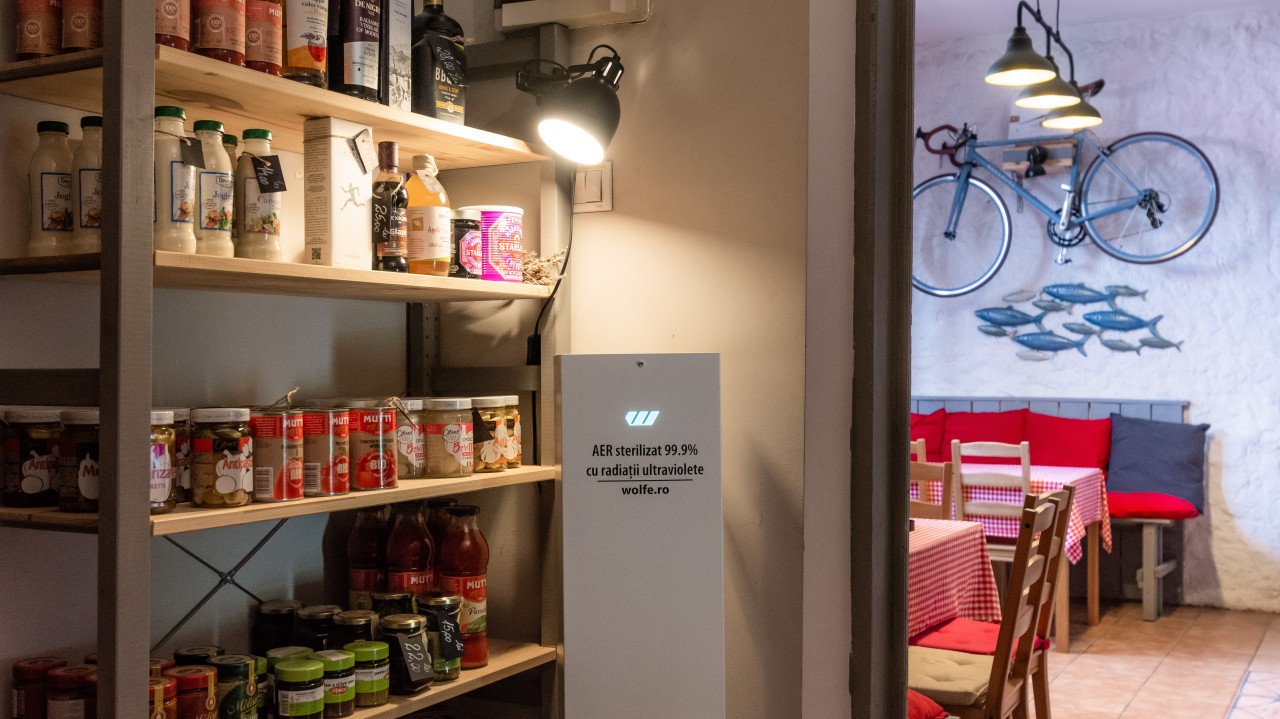
Restaurants present a different situation: the space must remain safe and functional while occupied. Here, air disinfection using suitable systems becomes relevant. Air is drawn into the device, exposed to UV-C in a protected chamber and then returned to the room. This allows the process to operate continuously, including in the presence of customers and staff, without directly exposing them to UV-C radiation.
The same principle may be relevant to supermarkets, serving areas, canteens and other indoor spaces where food, staff and a constant flow of customers are present at the same time.
UV-C does not, however, replace cleaning, ventilation or hygiene protocols. Cleaning removes dirt and residues, while disinfection aims to inactivate the remaining microorganisms. These are different levels of protection that need to work together.
Two Different Challenges: Surfaces and Air
This distinction is also important when discussing technology. For surfaces, one of the challenges is coverage of the space. A fixed UV-C source treats the area for which it has been positioned, while an autonomous system can move the source through the space, following predefined routes and approaching different surfaces in succession.
In a food production facility, an autonomous robot can be used in certain areas after production and cleaning procedures have been completed. In warehouses, it can travel along aisles and through logistics spaces, while in retail, interventions can take place outside public opening hours and under controlled conditions.
For air, the challenge is different. Air circulates constantly, and people continuously enter and leave a restaurant or shop. Here, a fixed or mobile device with shielded UV-C can continuously treat recirculated air, with a design that keeps the germicidal radiation inside the system.
These are, in fact, two different applications of UV-C technology, adapted to the two components of the environment: surfaces and air.

What Does Autonomy Bring?
In the case of air and surface disinfection robots, autonomy adds an important dimension: traceability. The route travelled, the time of the intervention, the time spent in a particular area and the process parameters can be recorded and checked.
In the food industry, where the traceability of products, ingredients and batches is already fundamental, an interesting question emerges:
If we can trace a product’s journey from its origin to the shelf, how well can we trace the process used to sanitise the environment in which it is produced, stored and sold?
We are no longer talking only about automating an action, but about enabling a stage of the process to become repeatable, measurable and verifiable.
From Hospitals to Other Environments
At Wolf-e Robotics, the experience we have developed in healthcare has led us to consider the two components of UV-C disinfection separately. One example is CoBOT Ultra, which uses autonomy for UV-C disinfection of surfaces and spaces under controlled conditions, while AER addresses another component: continuous air treatment, designed for operation in occupied spaces. This approach can also be considered in the food industry: an autonomous robot for certain stages of space and surface disinfection, and dedicated air treatment systems for areas where activity is continuous and people are present.
Every space has its own risks, workflows and characteristics, and technology must be adapted accordingly. The approach differs between a hospital, a factory, a supermarket and a restaurant, and begins with understanding the environment as a whole: air, surfaces, people and processes. From there, the appropriate solution can be selected for the identified risks.
Perhaps the question in the coming years will no longer be “where can we use air and surface disinfection robots?” but “which processes should become autonomous and measurable?”
Read More
- How to Choose the Most Effective UV Disinfection Robot for Air and Surfaces
- Shedding Light on UV-C Disinfection — Part 1
- Shedding Light on UV-C Disinfection — Part 2
______________________________________________________________________________________________________
We are Wolf-e Robotics, and every day we work to support our mission of disinfecting the air and surfaces in the places where we work, learn, and spend our time. Through disinfection with intelligent UVC light equipment and mobile robots, we provide the most efficient and environmentally friendly method of inactivating microorganisms on surfaces and in the air. With applicability in the medical, commercial, transportation, education, and corporate sectors.
Follow us on LinkedIn, X, Facebook and Instagram!
