
In hospitals, every second matters. Patients enter seeking recovery, yet unseen threats—bacteria and viruses—can turn treatment into new risks. Hospital-acquired infections (HAIs) remain a silent but often deadly challenge, demanding relentless vigilance from healthcare staff. Against this backdrop, UV light technology has emerged as a powerful, invisible ally—safeguarding operating rooms, ICUs, corridors, and even smaller medical practices
Globally, 1 in 10 hospitalized patients develops at least one HAI, amounting to over 90 million cases annually, with several million resulting in severe complications or death—a major burden on healthcare systems and a constant driver for innovation.
European Nordic Countries: Where Care Becomes Art and Technology
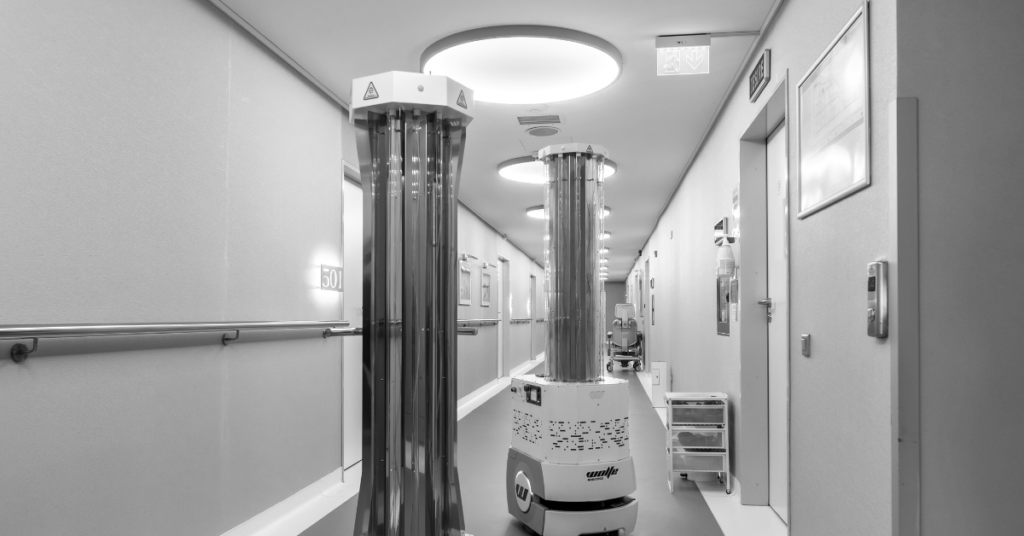
Scandinavian countries (e.g., Denmark, Sweden, Norway) have traditionally lower HAI rates, thanks to consistent investment in hygiene and infrastructure quality (under 4% of hospitalized patients, compared to the EU average of 6%). In Denmark, a key milestone was the collaboration between Odense University Hospital and a manufacturer, which led to the development of an autonomous UV robot (2016–2018). Denmark quickly adopted this innovation: in 2020, during the COVID pandemic, the Danish government facilitated, via an EU agreement, the deployment of 200 autonomous robots to hospitals across 10 European countries. These robots are used daily to disinfect operating rooms, ICUs, and other critical areas after routine cleaning. Results have been positive, reducing environmental colonization with methicillin-resistant S. aureus and enterobacteria.
Sweden and Norway, though having low MRSA incidence, have also implemented mobile UVC lamps in some hospitals, particularly for C. difficile control. A best-practice example comes from Karolinska University Hospital (Stockholm), which compared manual cleaning with UVC disinfection and found that while manual cleaning remains essential, UVC adds uniformity, minimizing residual bacterial load on surfaces, including hard-to-reach areas (under beds, equipment, etc.). Scandinavian hospitals also emphasize architectural design: some new hospitals are built to facilitate UVC robots (wider corridors, no thresholds, movable furniture, adapted elevators), recognizing that infrastructure must keep pace with technology.
Germany and the Netherlands: Precision, Standards, and Traceability
Germany has a robust infection control system, guided by KRINKO recommendations (Hospital Hygiene Commission). KRINKO guidelines on cleaning (2012, periodically updated) mention UV only marginally, and UVC is not fully adopted at the federal level. Nevertheless, top hospitals like Charité Berlin and university clinics in Munich and Frankfurt have conducted pilot projects with UVC systems. Germany emphasizes technical standardization. In practice, UVC is used mainly in two areas: (1) air disinfection in isolation rooms (ceiling-mounted UVC lamps with shields directing light to the upper room, common in TB wards), and (2) terminal room disinfection with UV robots in hospitals facing C. auris or other persistent pathogens.
Annually, approximately 580,000 patients in Germany acquire HAIs, ~35,000 associated with multidrug-resistant organisms, with an estimated 2,100+ deaths directly attributed to these infections.
Benchmark: Freiburg University Hospital reported that each Clostridioides difficile patient room undergoes a 15-minute UVC cycle post-discharge using a static device, reducing CDI recurrence by ~25%.
The Netherlands, known for its aggressive MRSA prevention program (“Search and Destroy”), maintaining an extremely low MRSA carrier rate (0.11% of hospitalized patients), also invests in technological cleaning solutions. Wilhelmina Hospital Assen (WZA) was the first in the Netherlands to adopt a UVC system, reporting that MRSA incidence in the orthopedic ward halved after routine UVC disinfection post-discharge. Dutch hospitals integrate UVC devices into digital quality management platforms—logging date, room, and duration of use—allowing managers to verify compliance and correlate with any subsequent infections.
United States: Demonstrated Efficiency and Financial Impact
In the U.S., UVC adoption is high, driven partly by commercial competition (companies like Xenex, Tru-D, Clorox Healthcare). Some states or hospital networks explicitly include UVC in their policies. Duke Health has been a leader in clinical research (BETR, FELICIA studies), integrating UVC into operational standards: every patient room with an MDR pathogen is UVC-decontaminated post-discharge, and operating rooms receive nightly UVC treatment (via mobile systems or fixed wall lamps activating automatically when unoccupied). While no federal law mandates UVC use, voluntary accreditation plays a role: The Joint Commission evaluates infection prevention programs, considering the use of modern technologies. Hospitals demonstrating comprehensive programs, including UVC or H₂O₂, may receive higher ratings in “Safe Environment” metrics.
Annually, ~1.7 million U.S. patients develop healthcare-associated infections, contributing to ~99,000 deaths, with total costs exceeding $30 billion.
APIC (Association for Professionals in Infection Control) and AORN (Association of PeriOperative Nurses) have issued guidance including new technologies. APIC’s 2020 whitepaper on “No-touch disinfection” concluded that “UVC is effective and cost-efficient as an adjunct measure to achieve high-level surface disinfection, especially when combined with standardized cleaning procedures” (example: one hospital saved $30,000/month by preventing infections and reducing isolation costs after UVC implementation).
Southeast Asia and Singapore: Smart Hospitals, Continuous Protection
Singapore is recognized for strict infection control. In recent years, hospitals such as Singapore General Hospital and the National Centre for Infectious Diseases have widely integrated autonomous UVC robots as part of a “smart hospital” strategy. A local study demonstrated that a programmable UVC robot could be implemented in operating rooms and ICUs without disrupting clinical flow, ensuring lethal UVC doses on >90% of surfaces. Singapore was among the first to combine UVC disinfection with IoT occupancy sensors: public hospital networks collaborated with tech firms to install motion and LIDAR sensors in corridors, which communicate with UVC robots that disinfect common areas (corridors, elevators) at night when confirmed empty. This autonomous approach reduces nighttime cleaning staff needs and ensures frequent, repetitive disinfection of critical areas, difficult to achieve manually.
Other Asian countries, such as South Korea and Japan, have also developed UVC robots, often integrating AI for object recognition to position lamps correctly relative to beds and equipment.
Benchmark: Seoul National University Hospital uses a blockchain-based traceability system for disinfection: each UVC cycle by a robot is recorded on a private hospital blockchain, creating an immutable record for auditors and eliminating the risk of manipulation or omitted reporting.
Singapore reports low MRSA and CDI prevalence, under 3% of hospitalized patients, thanks to integrated smart hospital strategies and UVC robots. Other regional countries (South Korea, Japan) have introduced digital traceability systems, reducing persistent HAIs by 20–30%.
USA vs. Europe – Different Approaches
While in the U.S. the focus has been largely on demonstrating clinical efficacy and ROI (Return on Investment)—hospitals want clear evidence that investments (ranging from tens to hundreds of thousands of dollars per robot) translate into reduced infections and financial savings—Europe places additional emphasis on standardization and occupational safety. For example, the United Kingdom, through the British Standards Institution, issued the BS 8628:2022 standard, along with specific NHS guidance highlighting that staff must be protected via door interlocks and sensors, and that any use of UVC must be preceded by clear signage (“DO NOT ENTER – UV DISINFECTION IN PROGRESS”). Some NHS trusts have even centralized control: specialized teams (e.g., decontamination teams) manage UVC devices instead of regular cleaning staff, ensuring both competence and procedural consistency.
And in Other Countries…
Countries with low rates of healthcare-associated infections (HAIs) share several common factors: consistent investment in infrastructure, ongoing staff training, and early adoption of innovative technologies such as UV light disinfection.
Beyond Scandinavia, Germany, the Netherlands, the U.S., and Singapore—already highlighted as benchmarks—other notable examples include:
-
France: Large hospitals such as Hôpital de la Pitié-Salpêtrière (Paris) have introduced combinations of technologies—UVC disinfection, hydrogen peroxide (H₂O₂) vaporization, and HEPA air filtration systems—for an integrated approach.
-
Israel: Medical centers widely use portable UVC for endoscopy suites and ICUs, while the Ministry of Health supports testing AI-based solutions to optimize exposure times and staff safety. Israel has reported a significant decline in nosocomial infections, with HA-BSI (healthcare-associated bloodstream infections) steadily decreasing between 2011 and 2019. Recent estimates suggest between 4,500–6,000 cases per year, marking a 50–70% reduction over the past 15 years.
-
Australia and New Zealand: Hospitals have integrated UVC into national “Zero Harm” programs. In Auckland, for example, every pediatric oncology ward undergoes a full UV disinfection cycle weekly, in addition to daily cleaning. Australian public hospitals reported an incidence of 0.75 SABSI cases (S. aureus bloodstream infections) per 10,000 patient-days in 2023–2024, down from 1.09 in 2010–2011. Annually, more than 170,000 HAIs are estimated, causing approximately 7,600 deaths.
Common Success Factors
Analyzing the experiences of different countries, it becomes clear that success in reducing hospital-acquired infections is not the result of a single technology, but of a combination of factors:
-
Digital traceability – every disinfection cycle is recorded and correlated with epidemiological data.
-
Staff training – UVC is viewed as a complement, not a replacement, to manual cleaning.
-
Adapted infrastructure – hospital design (movable furniture, wide spaces, optimized corridors) enables robotics to function effectively.
-
Integration with other technologies – UVC is often combined with HEPA filtration for maximum results.

Wolf-e Robotics & Wolf-e Systems: Romanian-Born, Globally Oriented
Wolf-e Robotics aims to become a key player in Romania’s automation industry — with a global mindset. With a solid structure, strategic affiliations, and a vision grounded in applied innovation, we believe that success in technology and manufacturing is not just about code, algorithms, or factory output. It’s about collaborative leadership, long-term partnerships, and the ability to build and scale through networks.
We are here to answer any questions you may have about Wolf-e Robotics systems and UVC light!
We are Wolf-e Robotics, and every day we work to support our mission of disinfecting the air and surfaces in the places where we work, learn, and spend our time. Through disinfection with intelligent UVC light equipment and mobile robots, we provide the most efficient and environmentally friendly method of inactivating microorganisms on surfaces and in the air. With applicability in the medical, commercial, transportation, education, and corporate sectors.
Follow us on Facebook, Twitter and LinkedIn!
