
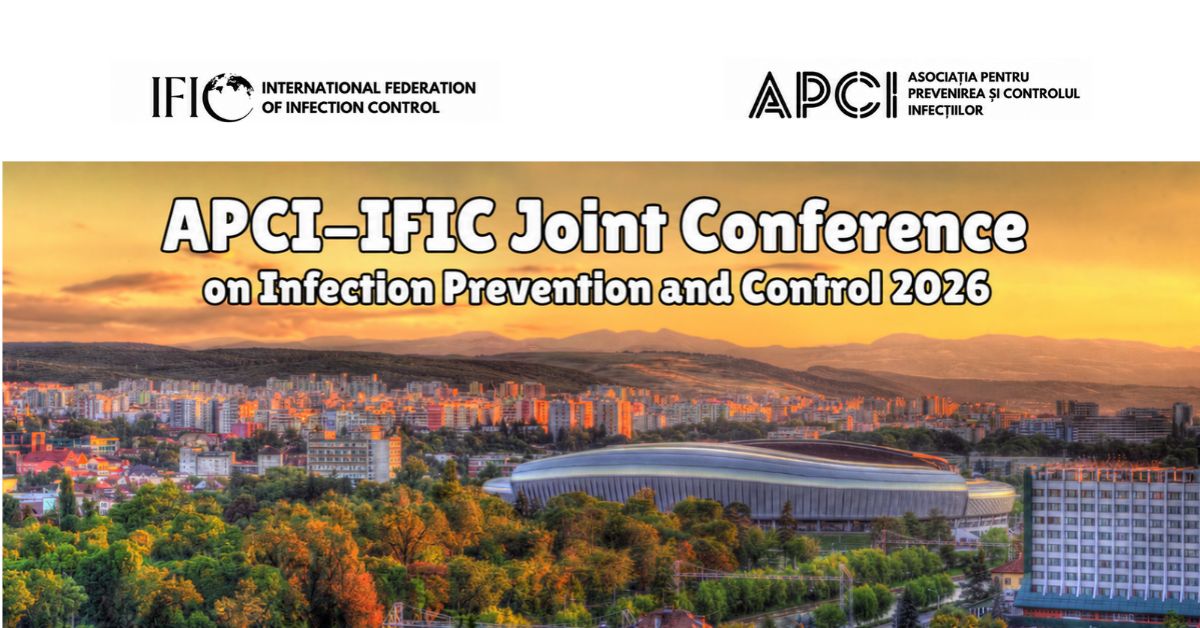
In Wolf-e Robotics’ October newsletter, we discuss the prevention of healthcare-associated infections (HAIs) and the connection between team training, professional collaboration and the correct use of technology.
Preventing hospital-acquired infections is a daily effort built on people who know the procedures, equipment used correctly and documented processes. Our partnership at the APCI 2026 Conference provides the context for discussing how we turn these principles into consistent practices.
Wolf-e Robotics was a partner of the APCI Conference for Infection Prevention and Control 2026, held on 8–10 October in Cluj-Napoca. Organised by the Association for Infection Prevention and Control (APCI), in partnership with the International Federation of Infection Control (IFIC), the 2026 edition brought together specialists from Romania and abroad to exchange experience, present scientific perspectives and develop professional collaboration.
Through its work, APCI promotes good practices in preventing healthcare-associated infections and supports the continuing education of healthcare professionals. The conference reflects this mission, connecting international expertise with the needs and experience of healthcare teams in Romania, in support of patient safety.
The participation of representatives from the Healthcare-Associated Infection Prevention Unit at Sibiu’s Pneumophthisiology Hospital, reported in the local press, illustrates the importance of these meetings for updating knowledge and exchanging good practices.

From Sharing Experience to Everyday Practice
Prevention means people who know the procedures, equipment used correctly and documented processes — every day.
For Wolf-e Robotics, supporting the professional community is connected to a practical question: how do we turn knowledge and technology into consistent prevention practices?
When integrating UV-C equipment, the answer involves training, organisation and verification. The examples below reflect our perspective on the use of technology:
After a Patient Is Discharged
The team carries out cleaning and disinfection according to the procedure, after which it can use UV-C equipment under the conditions validated for the respective application. For equipment that requires people to be absent, access to the room is restricted for the duration of the cycle.
When Preparing the Room
Staff check the positioning of the equipment and any obstacles that could prevent the target surfaces from being exposed. Placement and any repositioning follow the validated protocol.
When Training a New Colleague
Training includes practical exercises: checking the space, operating the equipment, observing safety measures and following the required steps if a cycle is interrupted.
When Documenting the Activity
Recording the treated room, date, operator and cycle completion enables the process to be tracked. These data document equipment use; demonstrating microbiological efficacy requires appropriate validation.
 A Practical Example: Shift Handover
At shift change, a log sheet or digital report can help the incoming team quickly identify rooms where UV-C cycles have been completed, interrupted interventions and spaces that have not yet been treated. For example, if a cycle has been interrupted, the situation is recorded and communicated to the colleague taking over responsibility, together with the steps to follow under the protocol. This keeps the information accessible to the team and allows continuity of the process to be checked.
Technology as Part of a Collective Effort
UV-C can complement prevention measures alongside cleaning, hand hygiene, ventilation and procedures specific to each risk. Integrating it requires collaboration between infection prevention teams, healthcare staff, cleaning staff and technical personnel.
Through its partnership at the APCI 2026 Conference, Wolf-e Robotics supports dialogue between professionals and closer connections between research, practical experience and technology.
From Procedure to Verification: Five Useful Questions
For teams using or evaluating a UV-C solution, a few questions can guide internal discussions:
- What do we want to disinfect? Air, surfaces or both, depending on the equipment’s validated applications.
- How do we integrate its use into the team’s schedule? With clear responsibilities for preparing the space, operating the equipment and verification.
- What confirms that a cycle has been completed correctly? The parameters and records specified in the operating protocol.
- What do we do when an interruption occurs? We follow a procedure familiar to operators before considering the process complete.
- How do we use the data collected? To identify incomplete cycles, operational difficulties and additional training needs.
For Wolf-e Robotics, these are questions worth discussing between technology providers and healthcare professionals. The dialogue supported by events such as the APCI Conference provides the context for bringing technical capabilities closer to teams’ practical needs.
Read More
- How to Choose the Most Effective UV Disinfection Robot for Air and Surfaces
- Wolf-e Robotics Robots and Digital Platforms Showcased at APCI 2025 for Safer Hospitals
- UV-C Disinfection Traceability: From Procedure to Verifiable Data
We are Wolf-e Robotics, and every day we work to support our mission of disinfecting the air and surfaces in the places where we work, learn, and spend our time. Through disinfection with intelligent UVC light equipment and mobile robots, we provide the most efficient and environmentally friendly method of inactivating microorganisms on surfaces and in the air. With applicability in the medical, commercial, transportation, education, and corporate sectors.
Follow Wolf-e Robotics on Facebook, Instagram, LinkedIn and X for company news and updates. You can also contact us directly at office@wolfe.ro.
