
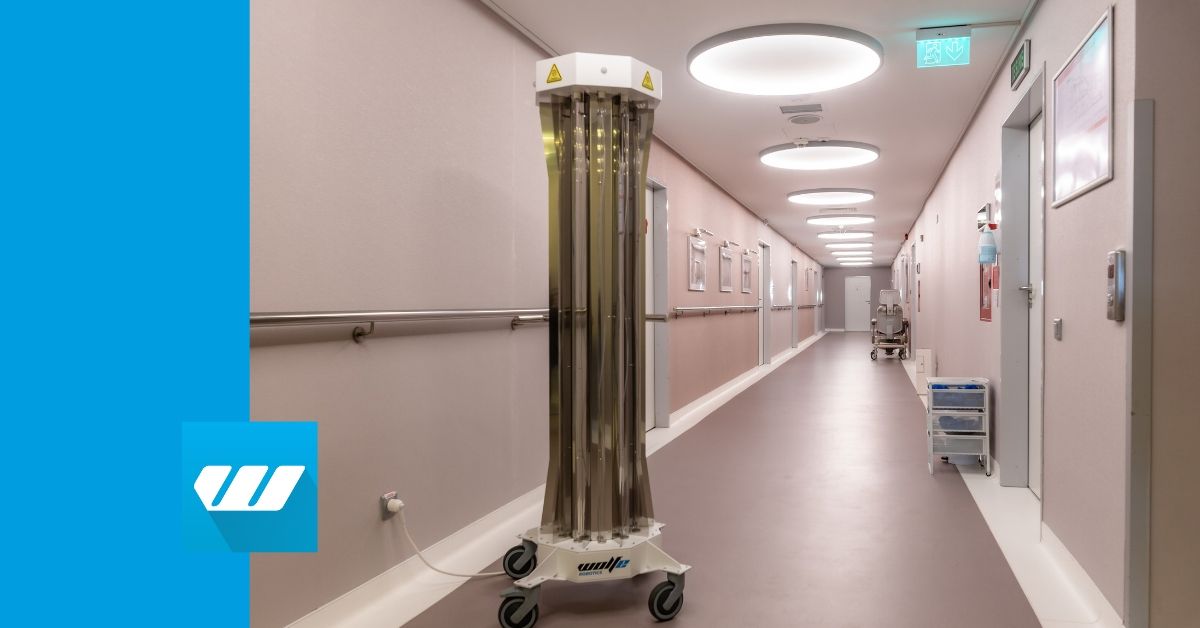
Disinfection of mobile equipment in the ICU needs to be organized for each use and transfer, according to the device’s risk category and the instructions. A room prepared for the next patient does not, by itself, confirm that all equipment leaving it or entering later has undergone the required procedure.
For us at Wolf-e Robotics, this distinction deserves discussion together with healthcare teams. In the ICU and operating suite, prevention follows both rooms and the objects moving between them. An IV pole or trolley may change its area of use before the room undergoes terminal disinfection. The practical question is: how does the next colleague know that the item is ready for reuse?
Mobile equipment: follow the route as well as the room
Consider a hypothetical example: a trolley used in an ICU area is moved to a shared space. If its storage location does not clearly indicate its status, the next team has to reconstruct what happened. Was it cleaned? Was the required disinfection performed? Was it touched or used again after the procedure ended?
Starting here, a useful check can follow a single item from the end of its use until its return to service. We are not proposing a complex record for every action. We are looking for the point at which responsibility passes from one person to another and the information needed to make that handover clear.
Assign responsibility for each category
In its recommendations for cleaning noncritical equipment, CDC notes that responsibilities may be shared between clinical and cleaning staff. The method, frequency and responsible person need to be defined so that items are not missed. This guidance was developed for facilities with limited resources; we use it as a practical reference, adapted to the hospital’s procedures.
At ward level, this means clarifying who prepares the item after use, who checks completion of the required steps and where it is kept until its next use. An answer such as “the shift takes care of it” may leave the handover unclear. A designated person and a rule understood by both teams make the route easier to follow.
The distinction between noncritical external surfaces and components requiring specialized reprocessing must also be maintained. CDC’s device classification differentiates requirements according to contact with the patient. Environmental UV-C disinfection must not be confused with instrument sterilization or high-level disinfection of semicritical devices.
Candida auris: a reason to check shared items
In its statement of September 11, 2025, ECDC includes Romania among the five countries accounting for most Candidozyma auris cases, formerly known as Candida auris, reported in the EU/EEA during 2013–2023. This is historical surveillance context, not an estimate of this week’s situation or a rate for Romanian hospitals.
For preventing C. auris transmission, CDC recommends disinfecting shared equipment after use, identifying disinfected items and separating them from dirty ones. The same source states that evidence on no-touch methods, including UV, is limited for this organism; they should only supplement standard cleaning and disinfection. This does not establish validation of a Wolf-e product against C. auris.
Where UV-C fits into the equipment workflow
In a procedure that includes UV-C, room preparation and item positioning need to be established for the configuration used. An item brought in after a cycle has ended did not undergo that cycle. Nor does a record that a trolley was in the room demonstrate exposure of every surface: covered areas, distance and geometry matter.
Together with staff responsible for UV-C disinfection of air and surfaces, we can formulate the questions that need to be resolved before reuse. Is the item compatible with the method? Which surfaces are targeted? What verification supports the chosen configuration? Operating conditions and protection of people remain those specified in the equipment instructions and approved procedure.
Through Wolf-e OS, we record data about the room’s UV-C cycle, including the device, date, time and actual duration, according to the functions described in our article on UV-C disinfection traceability. These records support reconstruction of the procedure. We do not present them as an automatic inventory of items present or proof that every medical device has been reprocessed.
A clear handover that can be checked on the ward
For your next internal check, we suggest following the handover of one mobile item between two uses. If the team can identify its status, the responsible person and storage location without assumptions, the route is clearer. If different answers emerge, that is where the procedure deserves adjustment together.
We assess compliance with this workflow, microbiological results and infection trends separately. Reduced contamination does not automatically demonstrate reduced HAIs. Our contribution is to integrate technology into clearly defined steps, so that teams can verify what has been done and what is still needed.
We are Wolf-e Robotics, and every day we work to support our mission of disinfecting the air and surfaces in the places where we work, learn, and spend our time. Through disinfection with intelligent UVC light equipment and mobile robots, we provide the most efficient and environmentally friendly method of inactivating microorganisms on surfaces and in the air. With applicability in the medical, commercial, transportation, education, and corporate sectors.
Follow us on LinkedIn, X, Facebook and Instagram!
