
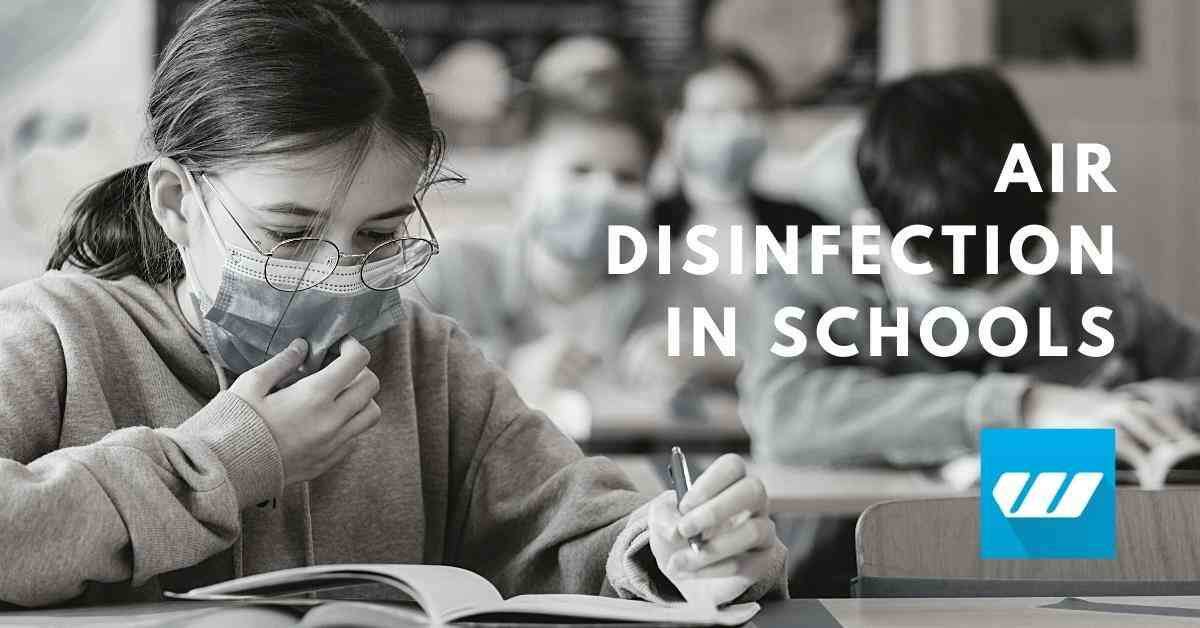
The issue is how to extend the face-to-face educational process as long as possible while taking into consideration the usual, the 4th and 5th waves of the epidemic, etc., now that school has begun in a physical format, i.e. in the classroom. Air purification in schools is beginning to take center stage on the agenda.
In order to safeguard kids and teachers, there are many critical considerations to make. The following information may and should be structured using the three-part hierarchy of infection control’s principles:

The use of this hierarchy was introduced in the 1990s in the United States during the epidemic of multidrug-resistant tuberculosis, a form of tuberculosis that does not respond to standard drugs, is more toxic, treatment is longer and less effective, and death rates are higher, despite the fact that this is usually a treatable disease. So the connections with Covid-19 are evident; TB is similarly an airborne illness, and many of the issues we face now were exactly issues we faced many years ago.
Our three degrees of applicability are as follows:
1

Administrative measures are the first and most significant part in this hierarchy, and may be thought of as Plan, Policies, and Protocols.
- a plan in which dangers are identified and current rules are amended with the help of important experts and stakeholders. Planning should be done in interdisciplinary groups of specialists and stakeholders (school administrators, public health experts, behavioral health, technical people, lawyers, communication people, religious leaders, parents, teachers and even students).
- The policies. They should be based on documented evidence and updated when new information becomes available. We’ve seen this a lot with Covid 19 since information is continuously updating.
- Protocols. What should be done if employees or children become ill? How should we convey this information?
2

The second aspect in this infection control hierarchy is termed environment and engineering, and it is frequently overlooked. UV-C light equipment is an important component that may be utilized in two ways:
- It may eliminate bacteria on benches, seats, and equipment surfaces, while also
- Disinfecting the air
Another important aspect at this level is the utilization of ventilation. Natural ventilation with open windows, cross drafts if possible, or mechanical ventilation with proper air conditioning systems are all options. We must also maintain a clean atmosphere in classrooms, gyms, canteens, and toilets, as well as maintain appropriate distances in various sections of the school.
3

Personal protection is the final step in the infection control ladder. This is what we have been dealing with the most in the last roughly two years. They include masks, visors, hand sanitization and washing, physical separation, staying at home if unwell, testing for Covid, and, most critically, immunization.
Contextualization. Air disinfection in schools.
Let’s wrap up by putting what I just said into context: all three levels are necessary, but since the start of this epidemic, the conversation has been on administrative controls and personal protection, and right now vaccinations are the subject of debate almost completely.
Yet, environmental control measures, a crucial component of this hierarchy, have likely received the least attention and care outside of the hospital setting. Although using UV-C light to clean the air has been the industry norm for decades, it has been costly and labor-intensive to install. However, new technologies are now available that can bring hospital-level hygiene standards to crowded settings like schools.
Lack of knowledge about the effects of the outside air quality on hospitals was also evident, and the high costs were a product of the healthcare system rather than the technology itself. Because of this, we investigated the most efficient techniques applied in hospitals and then adapted them to be usable in other types of places.
UV-C light has an overwhelming amount of evidence for its effectiveness since 1903. It has been used in medicine, in hospitals, for 80 years. It is shown in multiple studies that hospitals that use UV-C light disinfection towers have 93% fewer operating room infections than those that do not.
So we took these systems and made them available to schools in various forms. A classroom can be completely disinfected (99.99% surfaces and air) in just 5 minutes.
These systems apply the principles of physics rather than chemistry, which is incredibly intriguing and contributes to their exceptional efficiency. In this way, adopting UV-C systems allows us to use fewer chemicals that have negative effects on both the environment and human health. In reaction to the epidemic, ministries and decision-makers sprayed or nebulized the areas, railings, furniture, etc. This is problematic for a variety of reasons, including the fact that chemicals often only address surface disinfection, that there is a lot of room for human mistake, that it is bad for the environment, and that there is no way to monitor disinfection compliance.
This debate regarding the implications of indoor air quality and infection control for the school and beyond has been made possible by Covid-19.
Let’s assume that the air we breathe unites us all. The subject is actually far more broad than what we are doing to stop COVID. What steps are being taken to address the issue of E. coli and norovirus, as well as the common cold and seasonal flu?
Better measures and effective environmental tools can have a real impact on absenteeism caused by medical reasons such as those listed above. We at Wolf-e Robotics believe this is directly correlated to performance! By creating safer indoor spaces we can fundamentally change the education system. This is what we want to prove and achieve!
————————————————————————————————————
We are Wolf-e Robotics, and every day we work to support our mission of disinfecting the air and surfaces in the places where we work, learn, and spend our time. Through disinfection with intelligent UVC light equipment and mobile robots, we provide the most efficient and environmentally friendly method of inactivating microorganisms on surfaces and in the air. With applicability in the medical, commercial, transportation, education, and corporate sectors.
Follow us on Facebook, Twitter and LinkedIn!
